Andrew Watts: 'The IVC is a safe oasis'
Published 10 October 2024
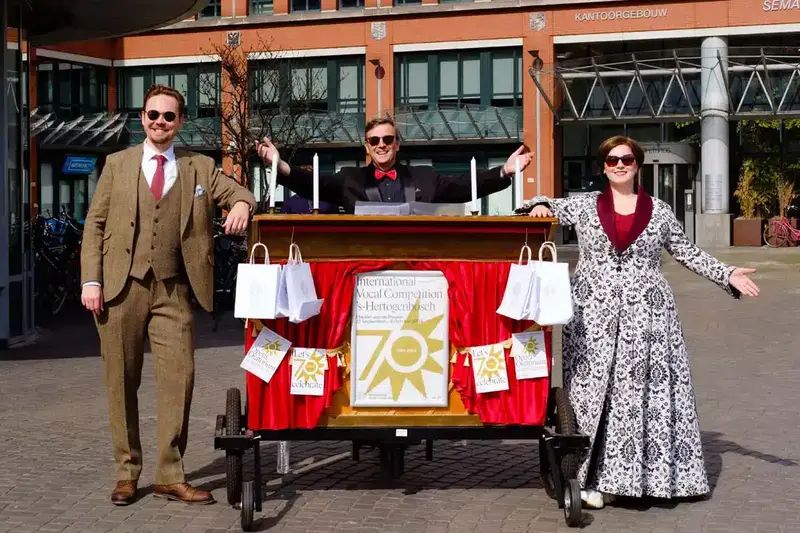
From Opera Magazine, by Bo van der Meulen.
How has the past year been as the new artistic and general director of the IVC?
It has been the most extraordinary year. A learning curve. Well, not even a curve - it just went straight up. I officially started on 1 September 2023, and by the end of that month I was presenting the Lied Duo competition and had to plan things for 2024. There were also things I needed to change. We looked very closely at the way the IVC was run and how it presented itself.
The IVC was always big on the international stage, but if you are funded by the municipality and the province of Brabant, you have to be visible there. So that is what we did: we expanded our visibility on social media by 2004%. We are now visible in the streetscape, we had a pop-up opera, we put on opera during the "Opera op de Parade" days, and more.
The funding plan for 2024-2028 has been approved and is widely praised. Yet we still struggle with sufficient funding from institutions. The arts are in this dreadful mess worldwide, including in the Netherlands, and you know that governments say, "we don't want music." I don't know where this nonsense comes from. Why would we not want the arts? It is supposedly elitist, but it is cheaper to go to the opera than to a football match!
We have entered into conversation with local schools. We have made contact with what I call the enthusiasts - the amateurs, the local people who now come to us, and we run workshops with them.
We have a new website, we have brand-new, smart newsletters, and we are also building relationships with other organisations. We now have a very close relationship with the Dutch National Opera Academy and the Young Artists Studio of Dutch National Opera. Thanks to me, as a singer, we have access to all the young-artist programmes. We share a lot of information there and it works very well.
New activities
I have also set up a new plan called Pay What You Can Afford. To give an example: a student interested in music who lives in Groningen received a little note saying they should write to me. If they then wrote to me, they got a train ticket. They came, and they put a little money in the pot. We have to encourage people to come, and it is not about enormous profit from ticket sales.
Festival
We added the festival week. Alongside the competition we gave a concert on Friday evening with the Bach Collegium 's-Hertogenbosch, in which Dutch soloists sang.
We held a book presentation of Discovering Voices, in which we highlighted everything the IVC does.
We have masterclasses with Dame Gwyneth Jones, Eva-Maria Westbroek, Roberta Alexander, Michael Chance and Rosemary Joshua.
The World Federation of International Music Competitions holds its annual seminar here.
We are organising a lecture on sustainability in opera, and there is a round-table discussion on voices. Director Sir David Pountney is coming to give a lecture on the future of competitions and whether competitions are actually good for young singers. I can confidently say that they are. There are people in the world who say we should not judge these young artists. But they are judged their whole careers. You step onto the stage, and even before you have sung a note they say, "oh, I never knew he could sing that," or "look, he can't do that - one missed note!"
Andrew Watts succeeded Ivan van Kalmthout as director. You said you changed a few things from the past.
"I had to look at the kind of people I want to work with and enjoy. That is my task: I want to make something coherent, so that all the parts work together. If I promise to deliver something, I will deliver it. I am not willing to make empty promises. And the most important thing is that we do not perform for me, but for our young artists. I feel that organisations sometimes lose sight of exactly what they are doing. I want to make people enthusiastic about everything the IVC does and make them realise that it is at the highest possible level - even these school workshops we have just done. I think we should start at the highest level, without any compromise. The key idea is to offer potential; that is what this competition is for. It is absolutely about the three D's: Discover, Deliver and Develop. It is my task to ensure that the singers we have here this week land well - even those who did not reach the semi-finals should get a chance for that. I have set aside an afternoon when they come and sit with me and we can find out where they are in their careers, who they work with, where they can go. I think it is very important that there is a level of care for these artists."
When I spoke to you a year ago, you were planning to move to the Netherlands with your family. How much time are you now in Den Bosch?
"We had talked about it, but it is simply impractical. I try to be in the office ten days a month, but I have a singing career in which I am still very active. There are people who say you should have only one job. But actually I don't see it as negative, because I am still connected to the heart of the business where I place singers. Through having this job, I have access to, and conversations with, people I can talk to. And when they ask me, 'Do you have someone who can sing this or that piece in two years?', I can advise. I have to say, the nice thing is that the IVC is being re-embedded within the Dutch training system, because we have these collaborations with all the conservatories and all the artist groups. We are attracting some good Dutch singers."
How was it to immerse yourself in the provincial side of the competition? It is an international competition and you want it to stand on the world stage, but you deal with local sponsors and local authorities.
"We have very good sponsors who have been with us for many, many years. And they are all locally based, in the Netherlands and in the Den Bosch region. Politics naturally plays an important role in the IVC because we have to be funded by the politicians. But it seems we have bridged a new gap with the mayor. I have the mayor and the minister of culture on speed dial when I need them, and those are the relationships you have to cultivate as an artistic director. You never have to lecture these politicians. You have to listen to what they say, and you may disagree, as long as you make your position clear. We have an extraordinary host-family network that we could not do without. We are the only competition in the world that offers participants a host family. Our host families are extraordinary people and they live in the most beautiful houses. We have something truly special, but it needs to be polished up and put back as the jewel in the crown."
How much more do you need to make your dreams come true?
"Ideally I would want another €100,000 a year. The fact is that we are a very small team that works incredibly hard. There is steam coming out of the computers. The team is so dedicated, but we need more people if we are going to expand the IVC and do everything we can to make ourselves visible. For the city, the country and for the global arts and networks, we need people to help us. My ambition is absolutely realistic, but the resources I have must be re-examined to realise that ambition. We have only one full-time staff member and the rest are part-time, including me. A large part of the vision is about education - about training a new audience and training new singers."
In five years it is another big anniversary, 75 years of the IVC. Where do you see the competition in 2029?
"I see myself a little greyer! I see the competition as one of the top six competitions, on a par with Operalia, the Queen Sonja Competition, the Mirjam Helin International Singing Competition in Helsinki. I see our competition as a way to keep offering our participants an experience that cannot be found anywhere else. We offer a piece of the Dutch way of life and extraordinary opportunities for their careers. I would like to see it financially a bit more comfortable, and I would also like to see us expand into perhaps a children's or amateur competition."
What is the most important thing the singing world should say about the IVC?
"That it is inclusive, that it has an open-door policy and that it is very supportive - and that it is not just a competition. I stake my job on there not being a single participant this year who says they had a terrible time with us. Everyone must feel that the IVC is a wonderful place to have sung. It is about the singers' experience. I lie awake at night over this. As an organisation we are so fortunate to meet these young artists and to have an influence at the very first stage of their careers, and I know how hard this profession is. I want them to know that somewhere there is a little oasis that is cool and very pleasant and where you feel welcome. I believe we have a duty of care. I want singers to know that the IVC is a place to be, and where singers are well looked after."