Eva-Maria Westbroek: helping the next generation on their way
Published 23 September 2024
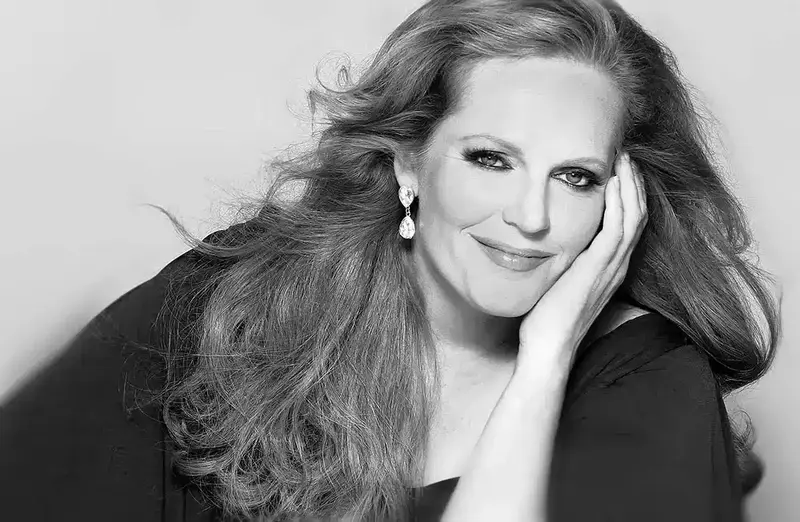
From Brabant Cultureel. Soprano Eva-Maria Westbroek, jury member of the IVC.
Some seventy singers from twenty-seven countries meet between 27 September and 5 October at the Theater aan de Parade in 's-Hertogenbosch, where the fifty-seventh International Vocal Competition for opera and oratorio takes place. The world-famous Dutch soprano Eva-Maria Westbroek is part of the jury.
"I'm on a break from singing," star soprano Eva-Maria Westbroek answers when asked whether she even has time to be a jury member at the upcoming International Vocal Competition (IVC) in 's-Hertogenbosch. "But I do want to stay involved with music, which is why I said yes. And I find Andrew Watts, the director, such a nice colleague."
"I have never been a jury member at a competition before, but I would like to try it. My good friend Roberta Alexander is also part of the jury, and that gives me confidence. Competitions are not a match for me. The few times I took part in one, I was full of stress - but for others a prize at a competition can mean the beginning of a successful career. The fact that the IVC is not a run-of-the-mill competition, but one where great names have won, convinced me."
Helping the next generation on their way
"To be able to help a next generation on their way to also become an Elly Ameling, Jard van Nes, Nelly Miricioiu, Pretty Yende, Dame Sarah Connolly, John Bröcheler or Robert Holl - to name just a few of the IVC's laureates - that is something I would gladly commit to. What's more, I get to give a masterclass, which I find delightful. I am going to do my very best and I hope to pass something on to the young colleagues."
"I have worked too long and too hard, and then it starts to creak and grind. I was tired, and that's why it is good to be home for a while. For thirty years I have not had this - being home for a longer period, taking a morning walk in the woods with Frank (her husband, tenor Frank van Aken) and the dog, teaching, and now having time for the competition. The life I have led until now was very exciting and great fun, but I never took a break, and because I always give everything, it became too much. That takes its toll, and that is why I am now pausing for a moment."
Very different from wearing a wig
"I did take part in competitions and even won a few things. In Rome I won, and at twenty-five I was allowed to sing the role of Tosca because of it, and elsewhere in Italy too I took second and third prizes. But at the Belvedere Competition - the springboard for young talent, mockingly called the 'Wall Street of Voices' - I didn't even get through the first round. You have to be able to handle the pressure such a competition brings. It is something quite different from standing on stage in a wig during a performance. Completely alone on the stage, as yourself. You cannot hide behind a character. That makes it extra difficult. Moreover, it is a snapshot. You have to be at your best on the evening of the competition. Not a week later."
"Competitions did not help me, even though I sang leading roles like Santuzza in Cavalleria Rusticana and Tosca at a young age. After those first prizes there was no follow-up and - as all the newspapers later wrote, when I did break through - I worked for a while as a singing waitress in an Amsterdam pasta restaurant. But for someone like Bryn Terfel or Dmitri Hvorostovsky, winning the Cardiff Singer of the World in 1989 was the immediate big breakthrough."
I'm just going to listen
"I have never been a jury member, so I am simply going to listen. Is the voice technically in place, is there an actor in this singer, am I moved musically and emotionally by what I hear? I have the immense advantage of sitting on the jury with very experienced colleagues: the living legend Dame Gwyneth Jones, Rosemary Joshua, the head of the Dutch National Opera Studio, Michael Chance - an English countertenor who, unlike me, has enormous experience with oratorio (I myself have really only done Verdi's Requiem regularly). And of course Roberta Alexander. I am a huge fan of hers; she has always supported me. It is sometimes claimed that on and behind the stage it is nothing but competition. I have never noticed any of that. Most singers support one another, Roberta most of all. So I dare to ask her and the other jury members anything."
"Singers who do not win are of course disappointed, but they must realise it is not the end of the world. Winning is nice, but taking part in a competition also yields something for the 'losers'. You learn from it, you hear which points you can improve and you can work on them. You can learn anything, as long as you are told what to improve."
No guarantee for the future
"And even if you go home with a prize, that is still no guarantee for the future. I myself experienced how a slump came afterwards. In the Netherlands I broke through, after some appearances at the Saturday Matinee, only at the Holland Festival of 2006 with Shostakovich's Lady Macbeth of Mtsensk. But that was also a production in which everything came together. Mariss Jansons, then chief conductor of the Concertgebouw Orchestra, conducted an opera again after years. He had once had a heart attack in the pit and had therefore avoided opera for a long time. The orchestra was superb, everyone went for it, the make-up, the chorus, the technical side - we had a perfect cast, wonderful direction, and the role appealed to me enormously. During rehearsals Jansons could be very direct and blunt in his instructions, but in the performance he gave me every cue; he dragged me through the whole piece. I am still crazy about that man."
Final scene, all on my own
"That I was able to experience something like that - that after the final scene I could take applause all alone on that great stage of the Stopera - fulfils my life. You have such an all-transcending experience only a few times in your entire career. La Fanciulla del West in London was one, for example, or the world premiere of Anna Nicole, the opera about the life of playmate Anna Nicole Smith under Antonio Pappano, also at Covent Garden in London, and above all Die Walküre with Sir Simon Rattle and the Berliner Philharmoniker. Again, everything came together. That is what you do it for; that is what you give everything for."